 When I was a child, my Tatay, who never had the opportunity to receive an education, gave me a book and said, “You will have a better future than me.” That simple, heartfelt gift became a turning point in my life. As a first-generation college graduate, a family breadwinner, and an academic scholar, my journey toward a professional career has been challenging but always guided by the promise he believed I could fulfill.
For my undergraduate studies, I pursued a Bachelor of Secondary Education in Physics as a university scholar at Mindanao State University-Iligan Institute of Technology in the Philippines. I later moved to Metro Manila, where I worked as a senior high school teacher for two years at the University of the East-Manila while earning a Master of Science in Applied Physics, Major in Medical Physics at the University of Santo Tomas as a DOST-SEI ASTHRDP-NSC scholar.
Driven by my passion for research, I worked as a senior science research specialist at the Philippine Nuclear Research Institute-Radiation Research Center before coming to UW–Madison.
I engaged in various training opportunities and experiments involving dosimetry for cell and small animal research. In 2022, I attended the American Association of Physicists in Medicine (AAPM) conference, where a conversation with Dr. Afua Yorke from the University of Washington inspired a research project titled, “Medical Physics Quality Assurance and Management Practices: A Survey in Radiotherapy Centers in LMICs,” which was extended to the Philippines. With cancer being the third leading cause of death in the Philippines and healthcare resources unequally distributed across regions, our study aimed to evaluate the current state of radiotherapy medical physics in the country.
We conducted an extensive online survey of 94 questions distributed to 22 clinics nationwide. The study provided valuable insights into medical physics practice and radiation therapy, including training, equipment availability, treatment modalities, quality assurance, and safety practices. It revealed significant disparities in facility distribution, limiting access to care for many cancer patients, especially those in rural areas. Although the number of radiotherapy centers is increasing, ensuring equitable access to treatment remains a critical goal.
The medical physics program at the University of Wisconsin-Madison offers an ideal environment for my academic and professional development, providing a close-knit and supportive community. Growing up in Iligan City, Philippines, known as the “city of majestic waterfalls,” I’ve always felt connected to places rich in natural beauty. Madison feels like a second home, not only for its academic excellence but also for its scenic lakes and peaceful surroundings that remind me of where I came from.
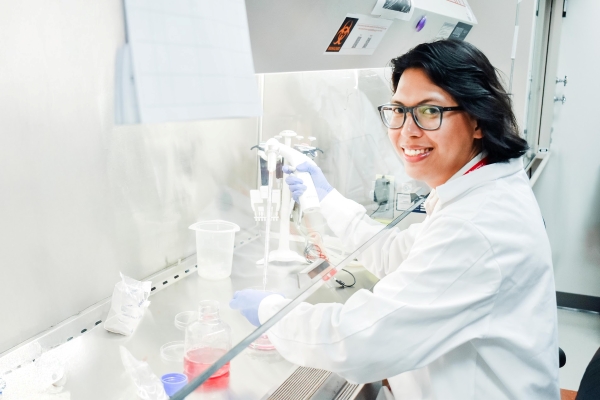 I am currently working under the mentorship of Dr. Reinier Hernandez in the Advanced RadioTheranostics (ART) Laboratory, focusing on the development of novel radiopharmaceutical agents for cancer diagnosis and therapy. I am particularly interested in exploring tumor radiobiology and how these agents can alter the tumor immune microenvironment and enhance the efficacy of immunotherapies. In summer 2024, I joined the Horizon Broadening Isotope Production Pipeline Opportunities (HIPPO), where I gained hands-on experience by working on a next-generation low molecular weight PSMA targeting molecule, ART-101, for 177Lu based radiopharmaceutical therapy in castration resistant prostate cancer (CRPC).
The results showed that [177Lu]Lu-ART-101 exhibited excellent radiochemical yield, purity, and stability. It demonstrated greater tumor uptake and retention compared to [177Lu]Lu-PSMA-617, while significantly reducing accumulation in normal tissues. These findings suggest that [177Lu]Lu-ART-101 is a promising therapeutic candidate for metastatic CRPC.
In my free time, I enjoy walking along the lakeshore during sunset, doing canvas painting by numbers, building block sets, making boba milk tea while watching movies, or simply spending a slow morning cooking. This summer, I am also joining hip-hop dance classes at Barrio Dance.
In the future, I hope to work in clinical or industry settings as a medical physicist and eventually return to the Philippines to serve as a career scientist at the Philippine Nuclear Research Institute. This goal is not only personal but also part of a broader vision to become a dedicated principal investigator and contribute to the advancement of science and healthcare in my country.
Reflecting on all that I have achieved and the journey that lies ahead, I always return to that moment from my childhood. The book my Tatay gave me was more than just a gift or a tool for learning to read. At the time, I didn’t fully understand what he meant, but it was the beginning of something much greater. That simple book led me to write my own stories and scientific articles, things I never imagined I could do. It became a symbol of hope and a reminder that education can truly move mountains. Though he is now in a better place in Heaven, I carry his love and wisdom with me every day. I know he is proud of the person I have become.