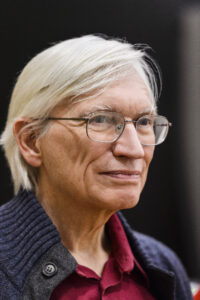
“The best advice I ever received was, ‘think of the patient first,’” said Emeritus Professor of Medical Physics Bruce Thomadsen, PhD. “That was from my mentor Lucille DuSault. That advice always works in this field. If you’re treating what you do as patient-centered, it keeps you focused on where to go and what to do.”
A sharp focus on the patient’s needs has guided Thomadsen throughout a career spanning more than 50 years. He’s a nationally recognized expert in radiation therapy physics, patient safety, and quality assurance.
His contributions to brachytherapy research are immense, and he has also demonstrated a long-standing commitment to patient safety, including the creation of a Patient Safety Organization (PSO) called the Center for the Assessment of Radiological Sciences.
In recognition of his eminent career in the field of medical physics, Thomadsen will receive the 2026 William D. Coolidge Gold Medal at this summer’s American Association of Physicists in Medicine (AAPM) annual conference in Vancouver.
Advancing Radiation Therapy
Thomadsen arrived in Madison after receiving a bachelor’s in physics from the University of Michigan, and master’s degree in physics from Michigan State. In 1989, he graduated with a doctorate in medical physics from the University of Wisconsin under mentor Dr. Bhudatt Paliwal.
Thomadsen’s medical physics research focused on brachytherapy, a type of internal radiation therapy used to treat cancer. More specifically, his research focused on improving brachytherapy treatment planning to preserve healthy tissue and enhance patient safety and outcomes.
This work led to several patents. For example, the patent, Directionally Emitting Radioactive Source for Brachytherapy, was awarded in July 2010 with collaborators Drs. Douglass Henderson, Liyong Lin and Wendy Crone.
The inventors described this patent as having “developed a radioactive source having a directional radiation emission pattern that allows improved treatment of tissue at the interface between diseased and healthy, radiation-sensitive tissue.
Thus, it is another object of at least one embodiment of the invention to provide sources uniquely suited for the region between healthy and tumorous tissue that can be used to create a sharper boundary in treatment between these two zones.”
The work to improve the design for a directional brachytherapy source continued in recent years, and in 2025, it was the subject of Thomadsen’s doctoral student, Akire Trestrail’s, dissertation titled, “Design Optimization and Evaluation of a Directional High-Dose-Rate Brachytherapy Source.”
A Commitment to Patient Safety and Service
Thomadsen is quick to answer the question, “What research project/work are you proud of?” with creating the Center for the Assessment of Radiological Sciences (CARS).
When patients arrive at the hospital for cancer treatment, they expect to receive the right dose of treatment in the correct location. But unfortunately, sometimes mistakes can happen. In 2012, Thomadsen recognized a growing need for a system to track these kinds of errors, and he created CARS in partnership with Drs. Rock Mackie, Jatinder Palta and Frank Rath.
This Patient Safety Organization (PSO) captures incident reports, analyzes data, and provides information about improving patient safety. At the time of its creation, patient safety organizations for radiation therapy did not exist, and today CARS is one of just two organizations providing this valuable insight. Most recently, work at CARS has been focused on streamlining the reporting system and improving usability for participants.
Read more about CARS at engineering.wisc.edu.
Service to professional societies has also been an important part of Thomadsen’s career. He was the first non-physician to chair the Advisory Committee for the Medical Uses of Isotopes at the Nuclear Regulatory Commission. He was also actively involved in the American Brachytherapy Society, serving as Physics Committee Chair from 2001-2005, and treasurer from 2009-2011. In addition, Thomadsen served on the Governmental Relations Committee for the American Society for Radiation Oncology from 2010-2017. Additional organizations of service include: American Academy for Health Physics, American Board of Radiology, Children’s Oncology Group, International Commission on Radiation Units and Measurements, International Atomic Energy Agency, and others.
While all of these organizations represent Thomadsen’s commitment to service and excellence, none exemplifies this more than his service to the AAPM. He joined the North Center Chapter of AAPM in 1981, and has been actively involved in shaping the organization ever since. In 2018, he served as president of the AAPM nationally.
Earlier in his career, he served as secretary, representative to the board of directors, and president of the North Center Chapter of AAPM. From 2016-2019, he also served as president-elect, president, and chair of the board for AAPM nationally. In addition to these leadership roles, Thomadsen participated in the administrative council, education council, professional council, science council, and numerous task groups and work groups. His record of service to the AAPM includes more than 150 distinct roles on these councils and committees.
Thomadsen continues to be actively involved with AAPM and will be presenting History Symposium: History of Brachytherapy on Sunday, July 19, at this year’s annual conference.
Celebrating Bruce Thomadsen
Thomadsen will receive the William D. Coolidge Gold Medal at AAPM on Monday, July 20, during the awards ceremony. It is the highest honor awarded by the AAPM. He joins a prestigious list of recipients, many with close ties to the University of Wisconsin, including:
- John Cameron, PhD
- Herb Attix, PhD
- Bhudatt Paliwal, PhD
- Willi Kalendar, PhD
- Rock Mackie, PhD
- Paul DeLuca, PhD
- Cynthia McCollough, PhD
At the ceremony, Thomadsen will be introduced by his mentor and fellow gold medal recipient, Dr. Bhudatt Paliwal. When asked about Thomadsen, Paliwal said, “He is a leader in the true sense. His professional life has been a living example of an all-around individual with an integrated personality of a great teacher, strong administrator, unbiased scientist with an emotionally developed kind heart.”